What’s in this guide
1. What the building is
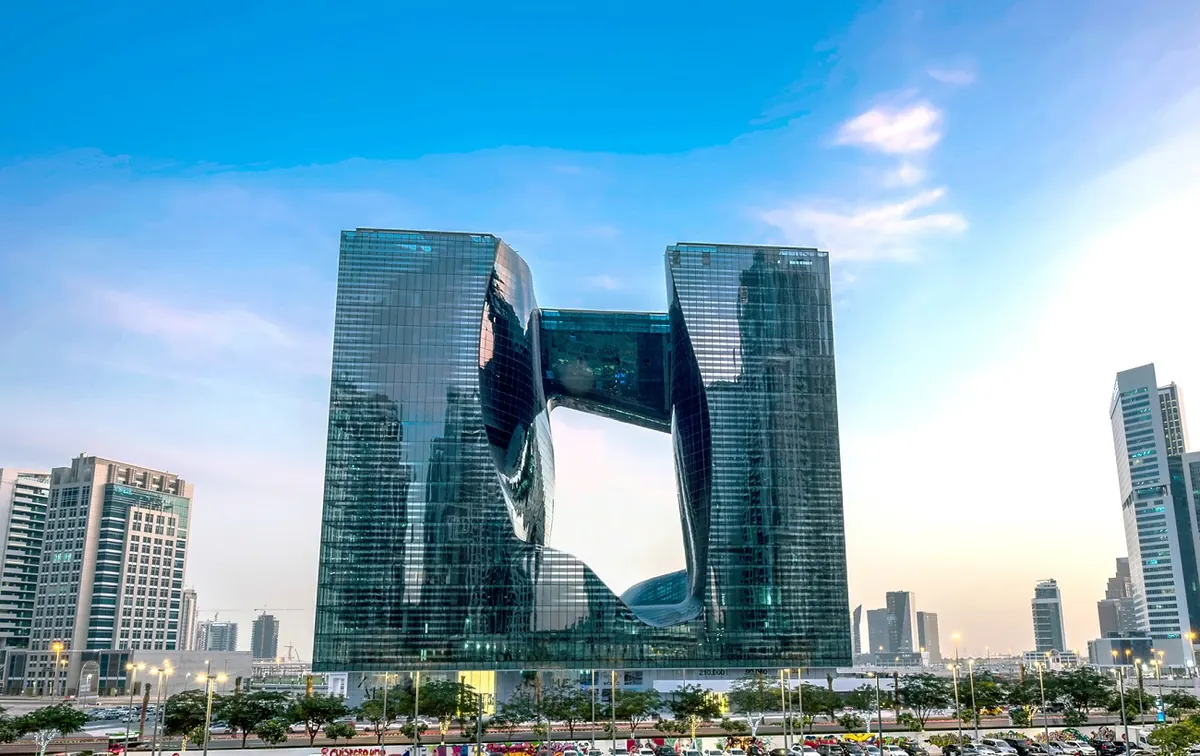
The Opus sits on Marasi Drive in Business Bay: two concrete towers that read from the outside as a single glass cube, with a free-form void carved through the middle of it.
The void is the whole idea. It is eight storeys tall and begins 71 metres above the ground, and its curved surface is a 6,000 square metre façade assembled from 4,300 individual glass units — flat, single-curved and double-curved, each one shaped for its own position. Where the two towers separate above the void, they are reconnected by an asymmetric bridge 38 metres wide and three storeys deep.
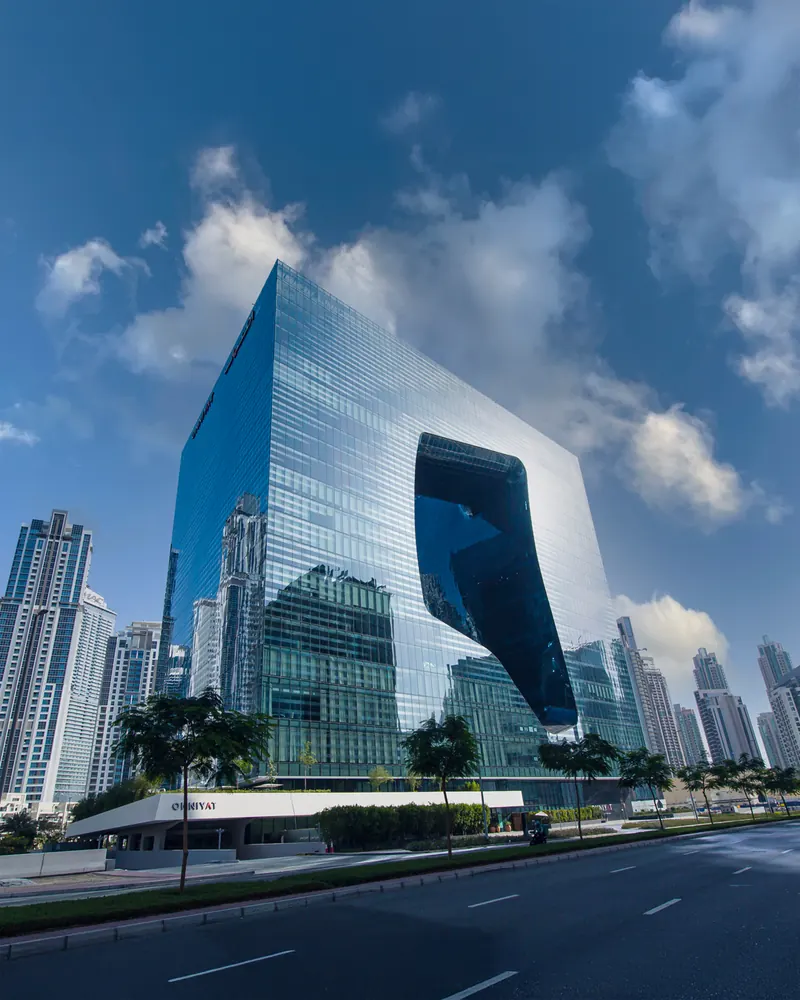
The rest of the numbers are ordinary by Dubai standards and deliberately so: 93 metres tall, 21 floors above ground and five below, about 84,300 square metres of built area. This was never a height project. Everything difficult about it is in the geometry.
Zaha Hadid Architects was the design architect. Brewer Smith Brewer Group was architect of record, Multiplex built it, and the developer is Omniyat.
2. What Zaha Hadid actually did here
You will see it said that The Opus is the only building in Dubai where Hadid designed both the exterior and the interiors. That version is a retelling, and it undersells the real claim.
What her own practice says is bigger. Zaha Hadid Architects describes the ME Dubai inside The Opus as the only hotel in the world in which the firm designed both the architecture and the interiors to that degree of detail — down to the bathrooms and the furniture.
Two honest qualifications, because they matter and they do not weaken the point:
- The claim attaches to the hotel, worldwide — not to the whole building, and not to Dubai specifically.
- The interiors were executed with HBA as interior consultant of record, alongside Zaha Hadid Design. She oversaw them; she did not detail every drawing alone.
The timeline is worth holding in mind when you stand in it. Hadid unveiled the concept in 2007. Construction stopped during the financial crisis and restarted. She died on 31 March 2016, with the building still under construction. The structure completed in 2017 and the hotel she designed opened in March 2020, four years after her death.
The recognition is real and checkable: the CTBUH Award of Excellence in 2019 for Best Tall Building under 100 metres, and AHEAD Middle East & Africa in 2020 for the hotel interiors. It was shortlisted at the World Architecture Festival in 2019 but did not win that one.
3. What is inside it
Three things share the building, which is unusual and affects everything downstream.
ME Dubai by Meliá — 93 keys, 74 rooms and 19 suites. The first ME by Meliá in the Middle East, opened March 2020. This is the hotel with the Hadid interiors.
The Opus Residences — Omniyat puts the count at 96 residences plus a penthouse, ranging from around 800 square feet to roughly 12,800. Simplex, duplex, triplex and penthouse layouts. They are fully furnished to Zaha Hadid Design and serviced by the hotel, which makes them branded serviced residences rather than plain apartments. Note that published unit counts disagree — the CTBUH registry records 60 — so treat the exact number as approximate.
Offices — roughly 56,000 square feet of Grade A floors, and importantly they are strata-sold, not only leased. Individual office units change hands, which is why this building has an office sale market at all.
On the ground, ROKA and The MAINE Land Brasserie are the names most people know.
4. The premium is real, and it is visible in transacted data
Here is where most write-ups stop at the asking price. The transacted record is more interesting.
Business Bay as a whole sits around AED 2,388 per square foot on the Land Department price index. Against that:
- Apartments in The Opus transacted at about AED 3,330 per square foot in 2026 — roughly 40% above the district.
- Offices transacted at AED 4,440 and AED 4,890 per square foot in 2026 — roughly 85% to 105% above the district.
That is not a marketing premium. It is a premium that buyers have actually paid and registered, and it is large. Whatever else is true about this building, the design commands real money.
The high-water mark is the office record: AED 20.26 million for 2,879 square feet on 23 September 2024 — AED 7,040 per square foot, the highest price per square foot the Land Department has recorded here.
5. What the premium has not done is compound
A premium and a growing premium are different things, and the difference is the whole investment question.
Three figures sit awkwardly together:
- The AED 7,040 per square foot office record was set in September 2024. The 2026 office sales cleared at AED 4,440 and AED 4,890.
- Apartment asking prices in the building are down about 16% year on year as of September 2026.
- Over the same broad period, Dubai prime residential rose about 8.4% year on year, and Business Bay apartments posted one of the strongest quarterly moves in the city.
So the building is holding a large premium over its district while moving in the opposite direction to both its district and its segment.
The reading that fits the evidence: the Zaha Hadid premium was capitalised into the price once, and has not compounded since. The first buyer paid for the architecture. The second buyer is being asked to pay for it again, and so far is declining to pay more.
Worth adding, in fairness: we looked for published research measuring whether architect-designed buildings in Dubai earn a measurable resale premium over time. No such study appears to exist. This building is a data point, not a proof.
6. Asking versus transacted, and why it matters here
The gap in The Opus is unusually wide.
- Offices are asked at AED 6,000 to AED 11,400 per square foot across 26 listings, and transacted in 2026 at AED 4,440 to AED 4,890.
- A four-bedroom penthouse was listed at AED 150 million in June 2025. No transaction corresponds to it.
Sellers appear anchored to the September 2024 record. An owner modelling their exit off portal prices is modelling a level the building has not reached since then.
For a buyer this is useful rather than discouraging. The negotiating room in this building is unusually large, and the transacted record tells you exactly how large.
7. Liquidity, stated plainly
Across its entire history since handover, the Land Department record for The Opus runs to roughly 50 sale transactions. In a building with around 96 residences plus office floors, that is a handful of deals a year.
Two consequences follow, and both are structural rather than temporary:
- There is no continuous price discovery. One unusual deal moves the building's apparent average. That cuts both ways, and it is why single-building averages here should be read with care.
- An exit takes time. This is not a unit you can decide to sell on a Tuesday. Across Dubai, only about 4% of homes sold in 2025 were resold within twelve months, against 25% at the 2008 peak — the whole market has slowed down on flips, and a 50-transaction building more than most.
One more piece of context that belongs here: of the 296 Dubai sales above ten million dollars in the first half of 2026, the concentrations were Dubai Hills Estate, Palm Jumeirah and Palm Jebel Ali. Business Bay did not feature. The Opus is an architectural landmark in a district the very top of the market treats as secondary.
8. The number that is missing
There is one figure a buyer needs here that is not publicly disclosed: the service charge.
We went looking across the portals, the agency building guides and the developer's own material. No building-specific service charge for The Opus is published anywhere.
The absence matters more than usual, because everything about this building points to a high figure. A 6,000 square metre curved-glass void made of 4,300 bespoke panels does not clean itself. Hotel-grade servicing, valet and five-star common areas all sit in the same budget. For scale: Business Bay averages around AED 14.75 per square foot, while Dubai's ultra-prime towers run in the region of AED 55 to AED 68.
The swing is not cosmetic. On a one-bedroom bought around AED 3.5 million, a gross yield of roughly 5% becomes about 4.65% at AED 15 per square foot, and about 3.6% at AED 60. The unpublished number moves the answer by nearly a third, which is why it should be the first thing you ask for and settled in writing before price is agreed.
9. Who The Opus is for
It suits a buyer who wants to own the building rather than trade it. There is one Opus. Hadid is dead, the hotel inside it is the only one in the world she designed inside and out, and nothing comparable is going to be built in Business Bay. If that is what you are buying, the architecture delivers it completely and the transacted premium says the market agrees.
It suits a buyer who negotiates off transacted evidence. The gap between asking and transacted here is the widest we have seen in a single Dubai building, and it is documented.
It does not suit a yield-first buyer until the service charge is on the table. Offices indicate roughly 5.6% to 6.2% gross and a one-bedroom around 5%, all before a charge nobody publishes.
It does not suit anyone who needs a quick exit. Fifty transactions in the building's lifetime is the honest measure of that.
And it does not suit someone buying the story expecting it to reprice upward on its own. On the evidence so far, the architecture is worth a large premium and is not yet worth a growing one. Buy it because you want it. That is a perfectly good reason at this end of the market — it is just a different reason from the one usually offered.
10. Questions people actually ask
Who designed The Opus?
Zaha Hadid Architects was the design architect, with Brewer Smith Brewer Group as architect of record and Multiplex as main contractor. The developer is Omniyat. Hadid unveiled the concept in 2007 and died in March 2016, before the building was finished.
Is The Opus the only Zaha Hadid building in Dubai with her interiors?
The accurate version of that claim is larger. Zaha Hadid Architects describes the ME Dubai hotel inside The Opus as the only hotel in the world for which the practice designed both the architecture and the interiors to that level of detail, including furniture. The interiors were executed with HBA as consultant of record.
What is inside The Opus?
Three components: the ME Dubai by Meliá hotel with 93 keys, The Opus Residences at around 96 units, and roughly 56,000 square feet of Grade A offices. Restaurants include ROKA and The MAINE Land Brasserie.
What do units in The Opus actually sell for?
On Land Department records in 2026, offices transacted at AED 4,440 and AED 4,890 per square foot and a one-bedroom apartment at about AED 3,330 per square foot. The building record is AED 7,040 per square foot, set on an office sale in September 2024. Asking prices sit well above these levels.
Is The Opus a good investment?
It carries a genuine, transacted premium of roughly 40% over Business Bay on apartments and 85% to 105% on offices. What it has not done is grow that premium — apartment asking prices are down about 16% year on year while Dubai prime rose. It reads as an asset to own rather than to trade.
What are the service charges in The Opus?
No building-specific figure is published anywhere. Given the curved-glass void façade and hotel-grade servicing, it is likely to sit well above the Business Bay average of around AED 14.75 per square foot. Because the figure swings yield by roughly a third, it should be settled in writing before a price is agreed.
Can you buy an office in The Opus?
Yes. The offices are strata-sold, so individual units change hands rather than the floors being leased only. There were 26 offices listed for sale as of September 2026.
How tall is The Opus?
93 metres, with 21 floors above ground and five below. It was never conceived as a height project — the difficulty is in the void and the geometry, not the scale.
Looking at a unit in The Opus?
Send Ali the floor and the asking price. He will pull what the building has actually transacted at, and what the service charge does to the return.
Sources & verification. Height, floor counts, built area, completion year and the professional team per the Council on Tall Buildings and Urban Habitat building registry. Void dimensions, bridge dimensions, façade panel counts and glazing build-up per Zaha Hadid Architects’ published project material. The scope of Zaha Hadid’s involvement is quoted as the practice itself states it, and the wider “only building in Dubai” formulation is not repeated because no primary source supports it. Hotel key count per Zaha Hadid Architects and CTBUH; Omniyat’s own material states a different figure and the discrepancy is noted. Residence counts differ between Omniyat and the CTBUH registry and are given as approximate. Awards verified individually with the awarding body and year; Omniyat’s claim of twenty-two awards is not repeated because no list is published. Transacted prices per square foot, the September 2024 building record and the lifetime transaction count are from Dubai Land Department registration records — a recorded gift transfer and a mortgage registration were excluded from the 2026 figures because neither is an arm’s-length sale. Asking prices and listing counts per Property Finder, September 2026, and are labelled as asking throughout. Business Bay index, Dubai prime price growth, the H1 2026 count of sales above ten million dollars and the 2025 resale-within-twelve-months figure per Land Department data and agency research. No service charge figure is quoted because none is published for this building.